
- There’s no scientific evidence that dogs can see ghosts or spirits, but their senses are sharp enough to make it look that way.
- Dogs have far stronger senses of smell, hearing, motion and low-light vision, and touch than people, so they often react to real things we can’t detect.
- No one can prove or disprove a canine “sixth sense.” Believers and skeptics agree that dogs notice more than we do.
- Staring, growling or avoiding a room can also point to medical or anxiety-related causes, so don’t assume it’s supernatural.
Most dog owners have seen it. Your dog stares at a blank wall, freezes in the middle of a hallway or refuses to walk into a room that looked perfectly normal a minute ago. Then comes the question that crosses almost every pet parent’s mind: Is my dog reacting to something I can’t see? (Or maybe even: Can dogs see ghosts?)
The idea feels natural, because dogs often act as though they know something we don’t. This article covers what’s actually happening when your dog behaves that way, why a dog’s senses make the “ghost” explanation so convincing and what experts say about the so-called sixth sense.
Can dogs see ghosts or spirits?

If you’re wondering, “Can dogs see spirits?” there is no scientific proof that dogs can see ghosts or spirits of any kind. Still, a dog’s senses are sharp enough to make it look that way.
Some pet parents and self-described mediums believe dogs sense paranormal activity, and they point to staring, whining and sudden fear as evidence.
Behaviorists and veterinarians offer a different explanation. They attribute these reactions to sensory input that humans simply cannot detect.
When people ask, “Can cats and dogs see ghosts?” the honest answer is the same for both: No research confirms it, and ordinary senses explain most of what owners observe. (Cats get a closer look in the FAQs below.)
The question of whether dogs can see spirits will likely stay open for believers. For everyone else, the more interesting story is how much dogs perceive that people miss.
Why dogs seem to react to the unseen
Many pet parents may reasonably wonder can dogs sense paranormal activity when their dogs seem to be reacting strongly to particular areas in their houses.
The movie “Poltergeist” portrayed the family dog as sensing the spirits that invaded the house, but what might the dog really have been seeing?
The truth is far simpler, and it answers the question, “Can dogs see things humans can’t?”
A canine’s senses far outstrip a human’s. That gap explains why dogs so often seem to notice things people can’t.
When your dog barks at an empty corner, something real may be triggering the response, even if it’s invisible to you. Four senses do most of the work.
A dog’s powerful sense of smell
A dog’s sense of smell is its superpower. Dogs have hundreds of millions of scent receptors, compared with the few million humans have, and a large part of the canine brain is devoted to processing smell.
A dog can detect a faint odor from a mouse in the wall, a spill that dried weeks ago or a visitor who left the house days earlier.
So when your dog stops in a hallway to sniff the air, it may be following a scent trail you will never notice. Because the source of the smell is invisible to you, the reaction can look supernatural.
Dogs can also detect changes in human body odor linked to stress or illness, which may explain why they sometimes react strongly to a person or place for no obvious reason.
A dog’s sharp hearing
Dogs’ hearing range extends well beyond ours. They pick up higher-pitched sounds and can hear noises from much farther away.
A pipe settling inside a wall, a rodent scratching in the attic or an electronic device humming at a frequency you can’t register can all grab a dog’s attention.
When your dog lifts its ears, tilts its head and fixes its gaze on a spot, it is probably tracking sounds you can’t hear. From your perspective, the dog is looking at nothing. From the dog’s perspective, something is clearly there.
What dogs can see that humans can’t
Dogs see the world differently than we do. Their eyes handle low light better than the human eye, and they excel at detecting motion.
A moth fluttering near the ceiling, a shadow shifting across the floor or a flicker of light from a passing car can register with a dog when it escapes your notice.
Some researchers also believe dogs can see a bit into the ultraviolet range, which could make certain surfaces and objects look different to them.
In short, your dog may be responding to an invisible-to-you stimulus that has a perfectly physical cause.
A dog’s sensitivity to touch and vibration
Dogs also feel their surroundings. They pick up vibrations through the floor, subtle air currents and changes in air pressure. Their whiskers help them sense tiny shifts in the air.
Distant traffic, a neighbor’s footsteps or a draft sliding through a gap in the door can all register physically, even when nothing is visible or audible to you.
Do dogs have a sixth sense?

Here the debate gets lively. People tend to land in one of two camps, and the honest, evidence-based answer is that no one can prove or disprove a canine sixth sense either way.
Believers
People who believe dogs have a sixth sense hold a few common views:
- Dogs can perceive spirits of all kinds. Believers say dogs sense the presence of human spirits, animal spirits or other supernatural entities that people can’t perceive.
- Staring is a sign of sensed energy. Believers interpret a dog’s fixed gaze at corners, walls or hallways as proof that the dog is tracking an unseen presence.
- Reassurance helps. Believers advise owners to speak calmly to a spooked dog and offer comfort, just as they would for any frightened companion.
Some believers go further. They connect dogs to practices such as seances, divination or ouija boards, claiming dogs react when people attempt to contact the other side.
Others describe a dog growling at a “demon” or turning to a medium for an exorcism after the dog howls at night. Stories like these spread widely, but they remain anecdotes rather than evidence.
Skeptics
Skeptics take a more cautious view:
- No scientific evidence exists. Researchers have found no proof that dogs can perceive ghosts or spirits.
- Heightened senses explain the “unexplained.” Skeptics attribute odd reactions to a dog’s superior smell, hearing, vision and touch.
- Rule out medical causes first. Skeptics recommend that owners consider health problems before assuming a supernatural cause.
Both sides agree on one thing: Dogs notice far more than we do. The disagreement is about what, exactly, they are noticing.
Signs your dog may be sensing something in your house
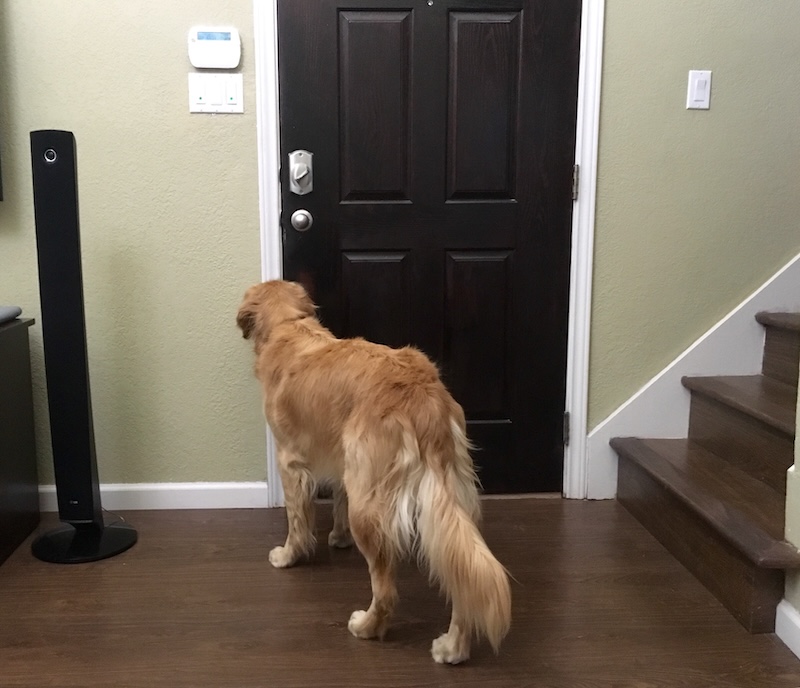
Certain behaviors make pet parents suspect their dog senses spirits in the house. Dogs showing these signs often leave their owners feeling uneasy.
Here are the most common ones:
- Staring at a wall, corner or hallway with no obvious cause. Your dog fixes its eyes on an empty spot and may not break the gaze even when you call its name.
- Barking, growling or whining at something invisible. Your dog directs its voice at an empty space. Some dogs howl or bark at nothing, which can alarm everyone in the home.
- Refusing to enter or avoiding a specific room. A dog that once loved the bedroom may suddenly balk at the bedroom door, or it may refuse to walk down a particular hallway.
- Sitting by the door or in one spot at unusual times. Your dog parks itself near an entrance or lies down in a certain place and seems to wait for something. Some dogs looked back at their owners as if asking for help.
Before you assume anything supernatural, remember that many of these same behaviors can also signal a medical problem. Seizures, vision or hearing loss, pain, and canine cognitive dysfunction (a condition similar to dementia in people) can all cause staring, restlessness, confusion or sudden fear.
If the behavior is frequent, sudden or increasing, talk with your veterinarian to rule out these conditions. Anxieties and fearful reactions to new noises or changes in routine are also common, and a vet can help sort out which factor applies.
Support your dog’s overall health and comfort
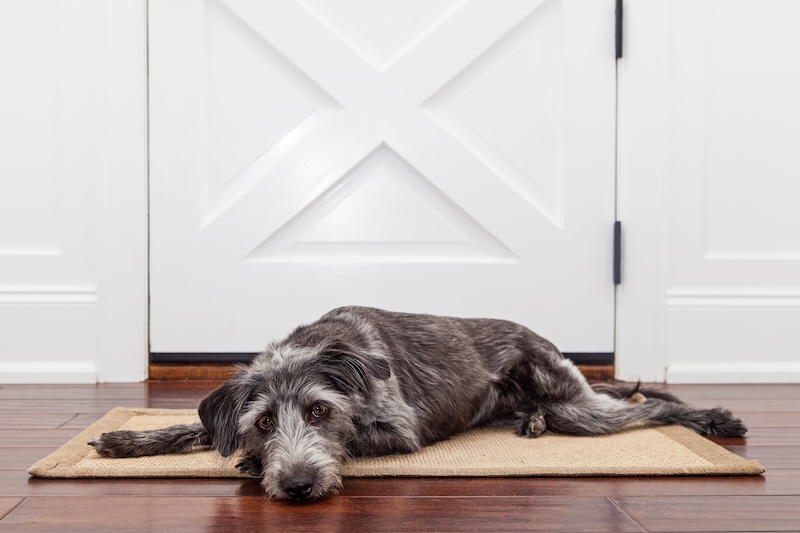
Whatever you believe about ghosts, one lesson learned is clear: A dog that stares, growls or seems scared deserves attention.
Start with the basics. Offer a calm environment, keep a steady routine and schedule regular veterinary checkups so you can catch health issues early.
A calm, well-adjusted dog also starts with good nutrition. A balanced diet can support already healthy brain function, energy, digestion and a healthy coat, all of which contribute to your dog’s comfort and confidence.
When a dog feels well, it handles unfamiliar sounds, smells and changes at home with far less stress. If you are curious about the best food for your dog’s age, size and health needs, ask your veterinarian for guidance.
Final thoughts
So, can dogs see ghosts? No evidence says they can.
Yet a dog’s sense of smell, hearing, vision and touch are so advanced that their reactions can look supernatural to us.
Believers see an unseen presence, while skeptics see ordinary senses at work, and neither side can fully prove its case.
What matters most is how you respond. Watch your dog’s behavior, stay calm and reassure a frightened pet.
If staring, growling or avoidance becomes frequent, sudden or worse over time, schedule a visit with your veterinarian to rule out medical causes. Support your dog with a steady routine and good nutrition, and you give it the best chance to feel safe, whatever it senses in your home.
Frequently asked questions
Can cats see ghosts too?
The same sensory reasoning applies to cats. Cats have senses sharper than ours in different ways. They hear very high-pitched sounds, see well in dim light and notice tiny movements.
Your cat might stare at an empty corner for the same reasons a dog does: It hears, smells or sees something you can’t. No evidence shows that a cat or a dog can see ghosts, but both animals perceive far more of the physical world than we do.
Can dogs sense when a loved one has passed away?
Some believers interpret certain dog behaviors as a sign that the dog senses a loved one who has passed. A dog might wander to a favorite chair, wait by the door or seem unsettled after a loss. Experts note that science can’t confirm a spiritual connection.
Dogs do respond strongly to changes in routine, scent and the emotions of the people around them, so a grieving household can easily unsettle a dog. Offering extra comfort and a consistent routine helps during these times.
Can dogs sense storms or other natural events?
Yes, and this one has solid support. A dog’s powerful sense of smell, along with its sensitivity to pressure and vibration, may allow it to detect barometric pressure changes tied to storms and other natural events.
Dogs often become restless, hide or seek out their owners before bad weather arrives. This reaction has nothing to do with the paranormal. It simply shows how finely tuned a dog’s senses are, and it offers a well-supported example of the so-called sixth sense in action.
- Brincat, C. (2025, October 23). Can dogs sense ghosts? Popular Science. (opens in a new tab)
- Cahn, L. Can dogs see ghosts? What the science says. Reader’s Digest Australia. (opens in a new tab)
- Anastasio, A. (2023, September 22). Can dogs see ghosts? American Kennel Club. (opens in a new tab)
- Kokocińska-Kusiak A, Woszczyło M, Zybala M, Maciocha J, Barłowska K, Dzięcioł M. Canine Olfaction: Physiology, Behavior, and Possibilities for Practical Applications. Animals (Basel). 2021 Aug 21;11(8):2463. doi: 10.3390/ani11082463. PMID: 34438920; PMCID: PMC8388720. (opens in a new tab)
- Jarmon, N. (2019). Can your dog hear you? Perceptions about canine hearing loss and noise exposure. Ursidae: The Undergraduate Research Journal at the University of Northern Colorado, 5(2), Article 3. (opens in a new tab)
- Törnqvist H, Somppi S, Kujala MV, Vainio O. Observing animals and humans: dogs target their gaze to the biological information in natural scenes. PeerJ. 2020 Dec 16;8:e10341. doi: 10.7717/peerj.10341. PMID: 33362955; PMCID: PMC7749655. (opens in a new tab)
- Jean-Joseph H, Bovet D. Haptic Signals as a Communication Tool Between Handlers and Dogs: Review of a New Field. Animals (Basel). 2026 Jan 21;16(2):323. doi: 10.3390/ani16020323. PMID: 41594510; PMCID: PMC12837276. (opens in a new tab)
- Ozawa M, Inoue M, Uchida K, Chambers JK, Takeuch Y, Nakayama H. Physical signs of canine cognitive dysfunction. J Vet Med Sci. 2019 Dec 26;81(12):1829-1834. doi: 10.1292/jvms.19-0458. Epub 2019 Nov 1. PMID: 31685716; PMCID: PMC6943310. (opens in a new tab)
- Sheaffer, S. (2026, January 27). Do dogs understand death? What science (and experience) really show. USA Dog Behavior. (opens in a new tab)
- Jordan, J. (2025, March 26). Why dogs act weird before storms: Smelling rain, hearing thunder and feeling static. Weather.com. (opens in a new tab)